Siberian Cat Colours & Patterns: Tabby, Solid, Neva Masquerade & More
Siberian cats come in nearly every colour and pattern a cat can have. If you have met one brown tabby Siberian, you have met exactly one Siberian: the next one you meet could be solid black, silver smoke, tortoiseshell, white, or a blue-eyed colourpoint Neva Masquerade. The breed’s dense, water-resistant triple coat is the same underneath, but the colour and pattern on top of it can look completely different from cat to cat.
That variety is part of the breed’s appeal, and it is also where a lot of confusion starts. Colour does not change a Siberian’s temperament – the affectionate, playful, loyal nature described in our Siberian cat breed guide is the same in a tabby and in a solid white cat. This guide explains each colour and pattern, what it looks like, and what it means for everyday care.
Tabby: the classic Siberian pattern
Tabby is the classic Siberian pattern and the one most people picture first. A tabby coat has dark markings on a lighter background. Tabby comes in four main forms. Mackerel tabbies have narrow, parallel stripes down their sides. Classic tabbies, also called blotched tabbies, have broad swirls and marbling instead of stripes. Spotted tabbies have stripes that break into spots. Ticked tabbies have each hair banded with light and dark, which gives a speckled look with little striping on the body.
Tabby Siberians come in many colours – brown tabby, silver tabby and golden tabby are familiar examples – because tabby is a pattern laid over a base colour.
Solid colours
A solid, or self-coloured, Siberian has one even colour from the roots to the tips, with no tabby markings showing in the adult coat. The solid colours are black, blue, red, cream and white. Black is a deep, even black. Blue is a soft slate-grey, the diluted form of black. Red is a warm ginger-orange. Cream is the pale, soft version of red. White is a coat with no pigment colour at all, and white Siberians can have blue, green, gold or odd-coloured eyes.
Red and cream cats can show faint “ghost” tabby markings that fade as the coat matures. That does not make them tabbies: a solid cat is named by the colour that dominates the adult coat.
Tortoiseshell and calico
Tortoiseshell – “tortie” for short – mixes black and red, or their diluted versions, blue and cream, in patches across the coat. Because the gene for red sits on the X chromosome, tortoiseshell Siberians are almost always female.
Add tabby markings to a tortoiseshell and you get a torbie, short for tortoiseshell tabby. Add white as well and the result is a calico: white with distinct patches of black and red. Calico is a pattern name, not a breed or a separate kind of Siberian.
Smoke, shaded and silver
Smoke, shaded and silver describe how much colour sits on each hair. In a smoke Siberian, the top of each hair is coloured and the part nearest the skin is pale or white, so the pale undercoat flashes through when the cat moves. Shaded cats have less coloured tipping than smoke cats, and silver cats have a white undercoat with dark tipping that gives the coat a bright, silvery look.
These effects can sit on top of other colours and patterns: a black smoke, a blue smoke and a silver tabby are all the same idea applied to different base colours.
Bicolour and white markings
Bicolour Siberians combine a colour or pattern with white. The white can be a small chest patch, a blaze up the face, white paws, a white belly, or large areas that cover most of the body.
Pedigrees describe this with the words “with white”, as in “black tabby with white”. A bicolour cat is still the same breed, with the same triple coat and the same care needs as a cat with no white at all.
Colourpoint: the Neva Masquerade
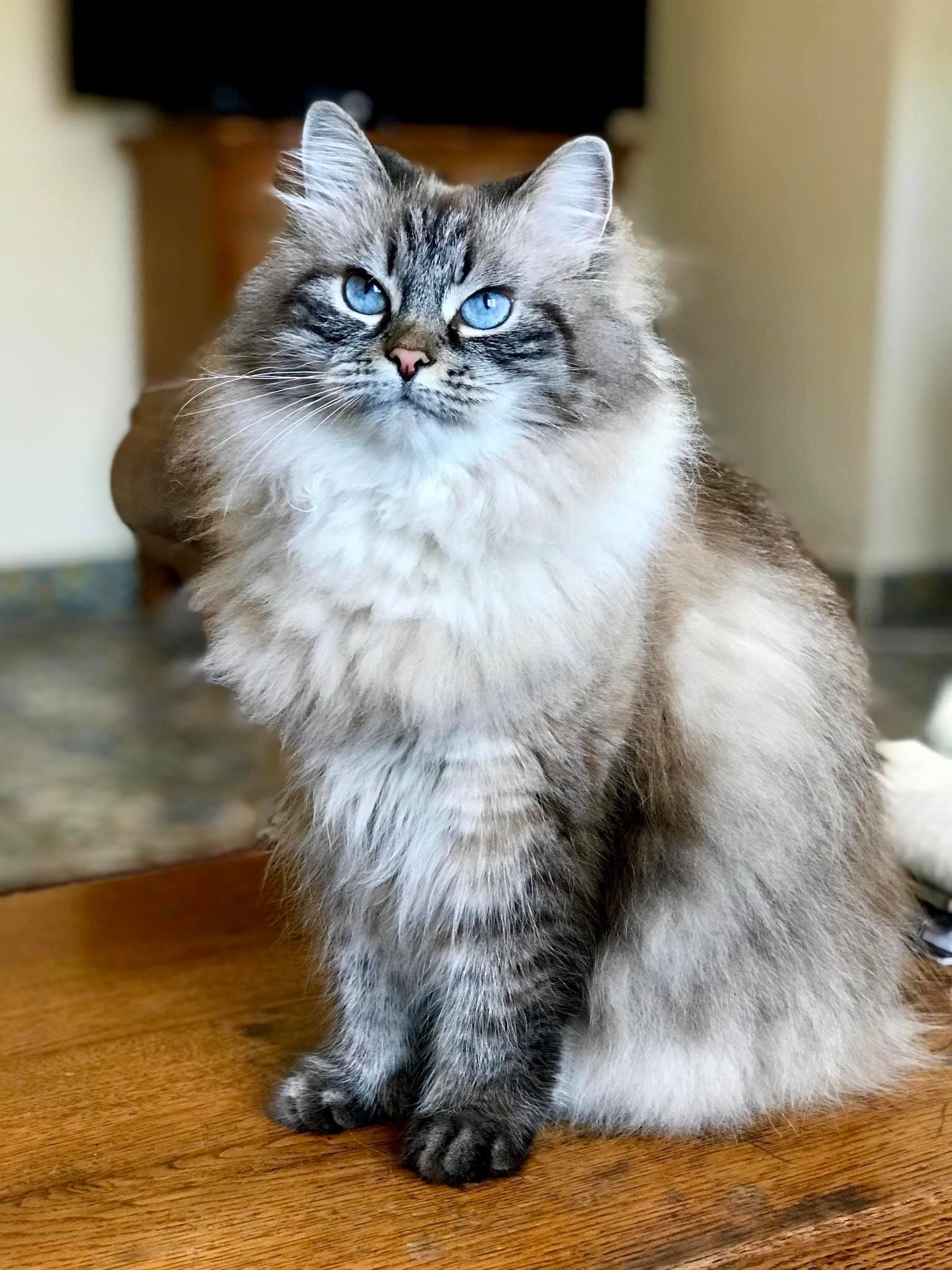
The colourpoint pattern is the one behind the Neva Masquerade. A colourpoint Siberian has a paler body and darker “points”: the ears, face, paws and tail. The contrast can be dramatic in a seal point cat and softer in a blue or cream point. Colourpoints almost always have blue eyes, which is part of what makes the pattern so striking.
The name Neva Masquerade comes from the Neva river in St Petersburg and the dark “mask” across the cat’s face. The International Cat Association (TICA) recognised colourpoint Siberians in 1997-98. A Neva Masquerade is a colourpoint Siberian, not a different breed: it has the same build, the same dense triple coat and the same temperament as any other Siberian, and it is shown and registered as a Siberian.
Point colours follow the same palette as the rest of the breed – seal, blue, red, cream and tortoiseshell points, as well as lynx (tabby) points such as the seal lynx point in the photo above.
Eye colours
Siberian eye colours range from green and gold to copper. Green is a common Siberian eye colour, and gold and copper give a warmer look that suits red and cream coats. Colourpoint Siberians, including the Neva Masquerade, have blue eyes, and some white Siberians have blue eyes too. Odd-eyed cats – one blue eye and one green, gold or copper eye – also occur, most often in white or bicolour cats.
What colour means for coat care
For everyday care, colour changes very little. Every Siberian, whatever its colour, has the same dense, water-resistant triple coat, and it needs the same brushing routine. Our Siberian cat grooming guide covers that routine in full, and our guide to Siberian cat shedding explains the seasonal coat change that all Siberians go through.
Colour does not predict how much a cat sheds, and it does not predict Fel d 1 levels – the protein most often linked to cat allergies. No colour is proven to be more hypoallergenic than another, so a “hypoallergenic colour” does not exist. If allergies matter to you, read our guide to whether Siberian cats are hypoallergenic before choosing a cat on colour alone.
Choosing a Siberian: what to ask a breeder
If you have a colour in mind, use it as a preference, not as the whole decision. Health, temperament and the breeder’s practices matter far more than whether a cat is a tabby or a solid. Ask the breeder how the colour is written on the pedigree, and what each word means.
Ask for photographs in natural light, and ask to see the parents if you can: a kitten’s adult colour is easier to judge when you know what the parents look like. Colour alone is not a price list either: our Siberian cat cost guide gives the site’s 2026 estimate range and explains what actually goes into the price. Pick the cat whose health and temperament fit your home, and let the colour be the bonus.
Frequently Asked Questions
What is a Neva Masquerade Siberian?
A Neva Masquerade is a colourpoint Siberian, not a separate breed. It has a paler body with darker ears, face, paws and tail, and blue eyes. The name comes from the Neva river in St Petersburg and the dark “mask” across the face, and TICA recognised colourpoint Siberians in 1997-98.
Do Siberian cats come in white?
Yes. Siberians come in solid white, and many other colours and patterns also come with white markings. White Siberians can have blue, green, gold or odd-coloured eyes. White does not change the cat’s temperament or care needs.
Does coat colour affect allergies?
No. No Siberian coat colour is proven to be more hypoallergenic than another, and colour does not predict Fel d 1 levels. Our guide to whether Siberian cats are hypoallergenic explains the evidence in full.
Does colour affect price?
Colour alone is not a price list. Breeders price a kitten on pedigree, health screening, care and other factors, not on colour by itself. Our Siberian cat cost guide gives the site’s 2026 estimate range and explains what goes into the price.
Do kittens change colour as they grow?
Yes, often. Colourpoint kittens are born pale and their points darken as they grow, and tabby markings can sharpen as the adult coat comes in. A kitten’s final colour can take time to settle.
Last updated: 15 November 2026.
Sources
- Cat Fanciers’ Association (CFA) – Siberian breed page
- The International Cat Association (TICA) – Siberian breed standard (PDF)
- Purina – Siberian cats
- Wikimedia Commons – Female Adult Siberian Cat with Seal Lynx Point Coat Color, by Ozwina (CC BY-SA 4.0)